














What is the first thing you think of when it comes to classic animated villains?
Is it their iconic, maniacal laughs? Their charming personalities? Or are you just like me and you think of the musical numbers that often accompany their heinous schemes. Here are some villainous songs that have done a dastardly good job at characterizing the malevolent mannerisms of animated villains.
Note: Click the colored dots to learn more about the characters and their songs.
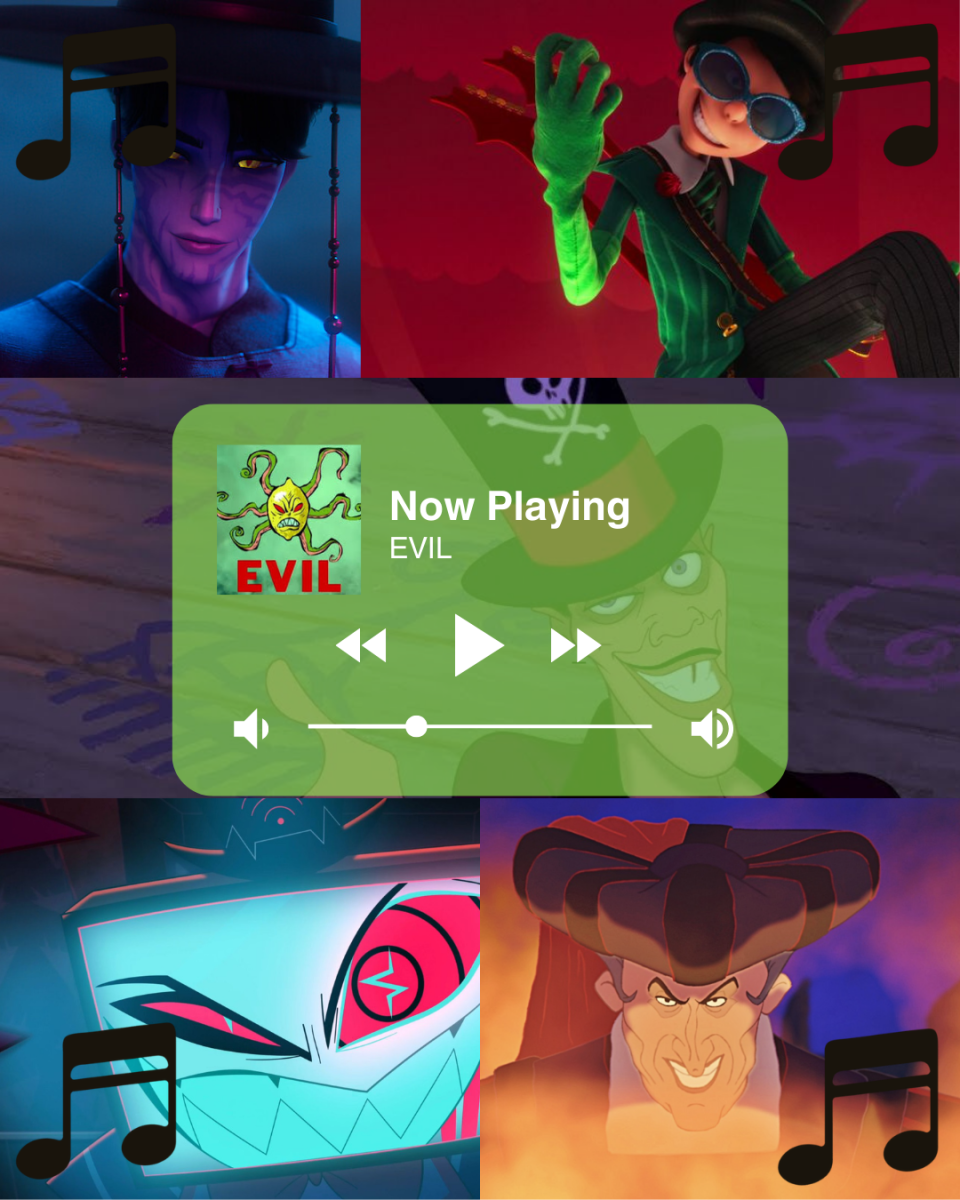
“Hellfire”: The Hunchback of Notre Dame
“Hellfire” is a masterclass of classic Disney animation and music that perfectly exposes the struggles of a despicable human being fighting a constant war against himself. Judge Claude Frollo fully believes that he is a flawless man of God, completely ignoring the fact that he tried to drown a baby, murdered an innocent woman, and chased a family in pursuit of eventually genocide all just in the opening scene of the movie. Eventually, a woman named Esmeralda becomes the center of Frollo’s lustful desires that deeply contradict his self-righteousness and religious piety. All of this culminates into “Hellfire,” a song so dark, Disney almost completely cut it from the film according to watchmojo. The demonic display of Frollo’s insanity that is “Hellfire” makes one question whether or not The Hunchback of Notre Dame’s G rating should be scorched in flames. You can read more about the movie it in my article “Five Underrated Animated Movies to Be Enjoyed by All Ages.”
“Brighter”: Hazbin Hotel
“Brighter” follows the rise to power and backstory of Vox, Hazbin Hotel’s media overlord. If you can bring yourself to excuse the heavy gore and rampant profanity that is obviously going to be present in a show taking place in hell, Hazbin Hotel is filled to the brim with amazing musical numbers and is centered around a compelling premise. The show follows Charlie Morningstar, Lucifer’s daughter, as she manages the titular “Hazbin Hotel”: a place where sinners can go redeem themselves to enter heaven. Vox is able to unite the masses of hell against their angelic oppressors; however, it is all just for his own gain. “Brighter” completely unveils Vox’s selfishness by revealing that as a human, Vox started off as a humble weatherman before going on a murdering spree, killing off anyone more powerful than him until he became an influential cult leader, showing that there is nothing he isn’t willing to do to, as he himself passionately sung, “Shine brighter, brighter than the heavens and the skies above!”
“Biggering”: The Lorax (2012)
“How ba-a-a-ad can I be?” is a question The Lorax’s Once-ler asks himself during the song of the same name; however, because this song ended up as “Biggering”’s replacement, it’s arguable that the true villain is Illumination. “Biggering” was cut from The Lorax not only because the song was deemed too mature for its audience of mostly children, but also due to it portraying greedy corporations as “too evil,” likely hitting too close to home for Illumination. In contrast to the upbeat, marketable, and catchy tone of “How Bad Can I Be,” “Biggering” is a rock song that delves way deeper into the psyche of the Once-ler as a character: criticizing his greed more harshly all while the Lorax tries to save him from his spiral into pure greediness. It’s criminal that what could’ve been a darker movie that leaned heavily towards critiquing greed was turned into a meme-able mess of a movie by the very thing it once sought to critique.
“Friends on the Other Side”: The Princess and the Frog
Dr. Facilier oozes jazz through his catchy villainous solo “Friends on the Other Side.” The doctor’s voice actor, Keith David (who also plays Husk in the aforementioned Hazbin Hotel) fits the role perfectly as his deep voice compliments Facilier’s alluring charm very well. This charm is crucial to Facilier’s character as he would not be able to manipulate Prince Naveen and his advisor without it. Facilier and his song are quite reminiscent of the classic Disney style but with the animation quality of a film released in 2009 (I personally adore the 2-D style of animation). The song’s visuals are also beautiful; Dr. Facilier’s shadow dancing alongside him is a much appreciated comedic addition, and when Facilier successfully ropes the two men into his shady deal, the visuals ramp up as his “friends” provide backing vocals for the remainder of the song. “Friends on the Other Side” does so much to emphasize the charismatic personality of Dr. Facilier that I don’t even know if I could resist making a deal with him, even though he is quite clearly scandalous.
“Soda Pop” and “Your Idol”: K-Pop Demon Hunters
Everyone has heard of K-Pop Demon Hunters. The demon boyband in the movie, the Saja Boys has become almost just as famous as their rival group, HUNTR/X, thanks to their devilishly catchy songs, “Sodapop” and “Your Idol.” “Sodapop” is both an earworm in the movie and in real life. The catchy tune has become iconic throughout the entire internet. Billboard.com reveals that both of the Saja Boys’ songs were immensely popular: placing in the Billboard Top 10 in the period shortly after the movie’s release. “Your Idol” has a more villainous tone in contrast to the upbeat “Sodapop” due to it being the final stage in the Saja Boy’s evil plan. Both songs are jams and have been in my playlist ever since I saw the movie. I’ve never been a fan of K-Pop, but the soundtrack of K-Pop Demon Hunters remains close to my heart and my ears.
These songs are essential to the characterization and development of animated villains. The inclusion of these catchy tunes provide these villains with a legacy to make sure that they will go down in infamy in the brains of those who watched their schemes unfold on the big screen.